Some cities are known for well water with high Iron levels. Deephaven, MN is one of them. What do you notice as you drive down the heavily wooded streets of this Lake Minnetonka community? Rust stains!
Our clients had just finished a beautiful landscaping overhaul of their entire property, and they did not want to ruin it! The beautiful Flagstone walkways that meander around the yard had started to turn orange after only one irrigation cycle!
They had to act fast!

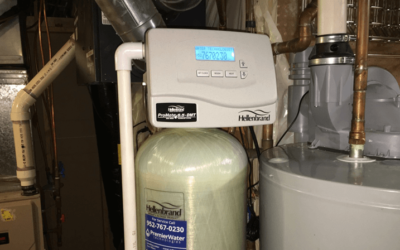
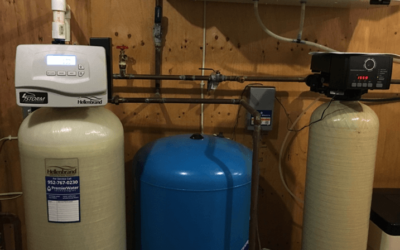
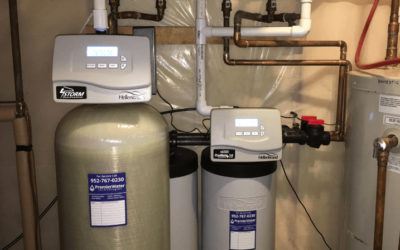
Our clients had been renting a Culligan Water Softener and a little Culligan Super S Iron Filter for years. The Water Softening process happens fast – very fast. Iron Filtration is a mechanical straining process, and it happens much more slowly.
If you look closely at the picture of the old equipment, you will see that the Softener is bigger than the Iron Filter.
So what does this mean?
Well for starters, Iron blew right through the little Filter making the Softener work over time by trying to remove both the Hardness AND Iron.
It also meant that they had rust stains, and they went through a ton of salt.

The irrigation system ran at a “continuous flow rate” of only 12gpm (gallons per minute), and it only ran at night when household water usage was non-existant.
During the day, the family of 5 could have multiple appliances and fixtures running. Their “peak” water use during the day was also around 12gpm.
Premier Water designed this Iron Filter System to the same specifications that a city would use for a water treatment plant. Our clients now have their own “private municipal water system”.
The 1st stage in the system uses an 18″ pressurized aeration vessel. When water enters this tank, it sprays through a compressed pocket of air that creates millions of little micro bubbles. These bubbles mix with water and oxidize Iron and Hydrogen Sulfide. These bubbles allow us to pre-treat the water without chemicals.
The 2nd stage uses a bank of (4) 14” filters that run in parallel. The quad filter system is capable of delivering 12.9gpm at municipal specifications. Each filter monitors water use, records system data, and can backwash based on time, volume, or pressure drop.
This “Whole House Iron Curtain Water Filter” treats everything: inside and out!

Now that the Iron has been removed, the new Softener essentially gets to live on city water. The Softener ended up being 33% smaller than the previous system, and uses about 50% less salt.
The Water Softener is a smaller version of a system that we install in many Twin Cities Restaurants. The digital controller measures water use, only regenerates with salt as needed, and constantly adjusts to operate at peak efficiency. It get’s smarter the longer it’s in the home.
News stories about Arsenic in Deephaven well water have brought drinking water quality to many of the local resident’s attention.
Reverse Osmosis (RO) by itself is only effective at removing Arsenic V, and not Arsenic III. Because of this, we used our standard Reverse Osmosis System and added a custom Arsenic Filter for their drinking water needs.
Our clients now have the best of both worlds: a scenic Deephaven home, without the poor water quality that so many suffer from!
No more rust stains, less salt, and clean drinking water. The whole project only took two days to complete, and now they will have great water with minimal maintenance!
Premier Water is a local, family-owned water treatment company based in Chanhassen, MN. Since 1978, Premier Water has successfully designed, installed, and serviced 1000’s of residential and commercial Iron Filtration Systems.
We offer a FREE WATER TEST to gather information and help our clients get the right water treatment solution for their needs. We can also be reached at (952) 479-4553 for more information.
Maple Grove water hardness is almost 5x higher than the national average.
It’s almost impossible to wash a glass in a dishwasher with Hard Water and have it come out looking clean.
While this is annoying for homeowners, this can be a deal breaker for a restaurant. What customer would want to take a drink out of a glass that looks dirty?

We are happy to announce that this is the 3rd water softener that we have installed for the owner of Kyoto Sushi. Like other restaurants, they chose our company because we deliver high performance products with quick, professional service.
To treat Maple Grove’s hard water problems, Premier Water worked in conjunction with the plumber to install a High Efficiency Water Softener in the back of their kitchen. The softener was put in place during construction, and the entire water softener system fit neatly on an elevated brick platform.
The controller, or “brain” of the softener, records and learns the restaurant’s water usage patterns. The system regenerates based on water volume, and automatically adjusts its capacity based on the water usage history it records.
This sort of “Green Technology” is very important to restaurants looking to save money by using less water and salt.
The entire system only uses 12V of electricity and will cost less than $2.00 per year to operate.
With their new water softener in place, the restaurant now has less than 1gpg of hardness. This means they will experience:
Soft water will save the Kyoto Restaurant $100’s a month, and allow them to spend more time serving their customers instead scrubbing away at hard water deposits.
Premier Water is a local, family-owned water treatment company based in Chanhassen, MN. Since 1978, Premier Water has successfully designed, installed, and serviced 1000’s of residential and commercial water softeners.
We offer a FREE WATER TEST to gather information and help our clients get the right water treatment solution for their needs. We can also be reached at (952) 479-4553 for more information.
Did you know that Perchlorate can now be found in virtually every human tested?
Perchlorates are salts derived from Perchloric Acid, which is widely used in Rocket Fuel and the Pyrotechnics Industry.

So what’s bad about having Perchlorate in your body?
This is a serious concern because Perchlorate is an endocrine-disrupting chemical known to disrupt thyroid function and hormone production by inhibiting your thyroid gland’s iodine uptake. Perchlorate has also been shown to affect brain development and growth of fetuses, infants and children.
Unfortunately, most Perchlorate salts are highly water soluble, and we’re now experiencing widespread land and water contamination in many areas of the world.
If you’re like most people, you buy organic food to avoid chemicals and contaminants.
If water contaminated with Perchlorate is used to irrigate crops, those vegetables will be tainted with high levels of this endocrine-disrupting chemical: whether certified organic or not.
A study on Perchlorate levels in North America reported that:
Unless something is done about the food production and distribution system, it is no longer possible to believe you can avoid toxins simply by eating organic.
In 2009, a government study found that 15 brands of powdered infant formula were contaminated with Perchlorate, a toxic compound in rocket fuel.
The two most contaminated brands, made from cow’s milk, accounted for 87% of the U.S. powdered formula market in 2000. Although the scientists did not identify the formula brands they tested, it was later reported that they were referring to Similac and Enfamil — two brands that dominate every supermarket in the United States.
Most people are exposed to Perchlorate through their diet in the form of contaminated water and/or foods. But infant exposure may be far greater than that of adults, especially if they are fed infant formula, as the toxin may be present in both the formula and/or the water used to prepare it.
According to the Environmental Working Group:
Perchlorate Data from the U.S. Environmental Protection Agency (EPA) shows that:
This contamination exists not only in drinking water but also in water used to irrigate crops. Water from the Colorado River is notorious for being contaminated with low levels of Perchlorate from aerospace and defense-related industries and it’s known that lettuce irrigated with Colorado River water is contaminated with Perchlorate.
Current research shows that Perchlorate does not absorb well through the skin.
Based on potential exposure, the most cost effective measure to take would be a drinking water system capable of reducing Perchlorate.
Drinking Water Purification
Carbon filters like those found in refrigerators and water pitchers have ZERO effect on removing Perchlorate.
A small under sink Reverse Osmosis (RO) system would be a cost effective treatment method for clean drinking water. For as little as $0.05 a gallon, you could have clean water and clear ice cubes.
An even more effective solution would be the LINX Drinking Water System. The LINX system uses TDS reduction cartridges made out of cation and anion resin. Anion resin has been shown to be even more effective at reducing Perchlorate than an RO.
In February, 2011 the EPA reversed its previous ruling, and set an enforceable limit on Perchlorate in drinking water. With Perchlorate showing up in places like organic food and baby formula, drinking Perchlorate-free water is one way you can limit your exposure.
If you would like to see what your options are for better water, sign up for a FREE WATER TEST. Upon testing your water, a specialist can review your options and technologies available to help you.
There’s nothing like taking a long hot shower on a cold winter night.
And when you need hot water, few things are more frustrating than waiting, and waiting, and waiting for the water to get hot.
Because 25% of your utility bill is spent heating your water, it makes sense to do it as efficiently as possible.
In 2010, there was a lot of excitement about Tankless Water Heaters and High Effiency Water Heaters. The push was so strong, you could even get huge rebates and tax incentives to install an energy efficient Water Heater.
But little attention was given to the actual water used in these heaters.
This article will take a deeper look at how Water Quality can make or break Water Heater efficiency and lifespan – regardless of make or model.
As water heaters age, they tend to accumulate sediment deposits and debris.
If your water takes longer to heat up, or it seems like you don’t have as much hot water as you used to, you might have sediment buildup in your tank.
Over time, sediment will build up to a level that acts as a barrier between the burner and the water. This has an effect equal to placing a stack of bricks on a stove, and then trying to boil water.
It makes it much harder heat.
An article published in a national ASPE plumbing journal states:
A water softener does a good job of protecting your water heater from up from Hard Water, but it offers zero protection from sediment buildup.
Combined with a reliable Water Softener, a mechanical Sediment Filter that removes sediment 20 microns and larger would go a long way towards protecting your water heater.
Pure Water contains only Hydrogen and Oxygen.
Most tap water is rarely “pure”. It usually contains salts, metals, disinfectants like chlorine and suspended particles (also known as Total Dissolved Solids).
In small concentrations, these contaminants are usually not bad for you even though they may contribute to poor taste and smell of the water.
These water contaminants also impart a slight conductivity to the water.
For this reason, many Water Heater manufactures recommend a maximum Total Dissolved Solids(TDS) limit of 500ppm:
Most water heaters are made of a steel tank with a porcelain enamel (glass) lining. Due to production and assembly methods, it is not always possible to completely cover the inside of the tank.
Therefore it’s important to provide metal that can be consumed by the electrical process. This is where the sacrificial anode rod comes in. By acting as a lightning rod for the corrosion process, the anode rod draws the harmful electrolytic process away from the water heater tank and focuses the corrosion on the anode rod. When this rod breaks down, it gives the hot water a “rotten egg smell”.
Water Softeners are effective at protecting water heaters from hard water damage, but the ion exchange process used to soften actually adds salt to the water. This increases the Total Dissolved Solid level, and can speed up the breakdown of the anode rod.
A Whole House Purification System like the Pureoflow, not only removes hardness and sediment, but it also removes dissolved salts and metals down to 0.0001 microns in size. The Pureoflow uses a type of Reverse Osmosis technology to physically separate pure water from the hardness minerals (dissolved rock).
Pure water that is void of hardness, sediment, salts, and metals, offers the best protection against corrosion in water heaters.
In the Twin Cities, the average groundwater temperature is 51 degrees Fahrenheit.
All year long, most mechanical rooms are kept somewhere between 65-70 degrees.
Whole house purifiers like the Pureoflow, literally make pure water 1 drop at a time. As each droplet is made, it is collected in a storage tank. This storage tank is installed in the mechanical room – right next to the water heater.
With a “Pure Water System”, the Water Heater only has to raise the water temperature from 65 to 140 degrees (75 degree increase), as opposed to 51 to 140 degrees (89 degree increase).
By giving a Water Heater an easier job, you get hot water faster, and it takes less energy to get it.
Soft water has been a staple for homes and businesses for years. Protecting water heaters from hard water has probably saved you $1,000’s of dollars in wasted energy and service repairs.
Pure water takes those savings to the next level, and it tastes better too
Premier Water is a local, family-owned water treatment company based in Chanhassen, MN. Since 1978, Premier Water has successfully implemented 1000′s of Residential and Commercial Water Purification Systems. We offer a FREE WATER TEST to gather information and help our clients with the right solution for their needs. We can also be reached at (952) 479-4553 for more information.
Somehow the idea of drinking pure water has been made questionable by several multi-level marketers.
You have to ask yourself:
Our company is obviously biased. We design, sell, and install Reverse Osmosis purification equipment for our commercial and residential clients.
Let’s take a step back, and look at the role water plays in the body. Then you can decide whether or not its quality or purity could have an impact on your health.
The human body is over 70% water, and as you can imagine, it plays several crucial roles in the body:
Each day we are exposed to toxins in the environment.
Health problems tend to occur when these toxins build up. Water is the only medium the body has to flush out these toxins.
It has been documented that the purity of water is directly related to its capacity to collect and cleanse these compounds from the body.¹
Does that mean that water could “strip mine” the body of its nutrients? NO! Cells in the body are smarter than that. They let in what they need, and they let out what they need. They are in control. Water can only remove the matter that the body allows it to.
“It is more important to have an adequate intake of water than it is to have enough calories. Water for drinking should be free of unpleasant odors and flavors in order to make sure the individual will ingest enough to meet his/her requirements.”
- Dr. Olaf Mickelson, former president of the American Institute of Nutrition
It is believed that mineral waters help furnish elements for body metabolism.
There is scientific proof that most of these minerals are in an INORGANIC (dead) form. While they may enter the body, they cannot be used in the physiological process of building the human cell.
Only after inorganic minerals have passed through the roots of plants do they become organic (through photosynthesis) and capable of being assimilated into our tissues as ORGANIC Minerals.
With this in mind, we can see that mineral water may give “dead” or “inorganic” minerals to the body which cannot be properly assimilated. These inorganic minerals only interfere with the delicate and complex biology of the body.4
The body’s need for minerals is largely met through foods, NOT DRINKING WATER.”
-The American Medical Journal
Another important fact to consider is that organic minerals in tap water only represent 1% of the total mineral content of the water.
Pure water removes the inorganic mineral deposits in your body. Organic minerals, on the other hand, are fully absorbed and remain in your tissues.
According to many nutritionists minerals are much easier to assimilate when they come from foods.
Purified Water could be considered low in Total Dissolved Solids (TDS) as it usually contains less than 50ppm of dissolved solids.
Most Tap Water in the Twin Cities could be considered “High TDS” as it contains 300-600ppm of dissolved solids.
On the surface, high TDS water is more of a nuisance. It may taste chalky, bitter, salty, or metallic and may have unpleasant odors. High TDS water is less thirst quenching, and can interfere with the taste of foods and beverages, and makes them less desirable to consume.
Many of the individual mineral salts that make up TDS pose no health risk. Other contaminants like Arsenic, Barium, Chromium, Fluoride, Manganese, and Nitrates can be problematic.
An Australian study reported that mortality due to ischaemic heart disease and acute myocardial infarction was increased in a community with higher levels of total dissolved solids and total hardness when compared with a community in which levels were lower.(31)
The results of a limited epidemiological study in the former Soviet Union indicated that the average number of “cases” of inflammation of the gall bladder and gallstones over a 5 year period increased with the mean level of dissolved solids in the groundwater.(32)
The current health standards that determine the allowable levels of contaminants we’re permitted to consume in our drinking water are based on the potential effects on adults, NOT children.
A child’s immune system and detoxification system are still developing throughout early childhood and teen years. Exposure to even very low levels of toxic chemicals or lead in drinking water at a young age can lead to increased risks of degenerative diseases and learning disorders in later years.
Since many of the crucial defense systems that help protect adults from disease and environmental pollutants are not fully developed in children, they are much more sensitive to contaminants.
We hope you agree that purified water looks pretty good after all. To our staff, families, friends, and clients, it’s a no-brainer.
Not only do we provide small Reverse Osmosis systems for drinking water, we also design and install Pureoflow systems for whole-house purification, and whole-business purification for restaurants.
Give us a call at (952) 479-4553 or sign up for a FREE WATER TEST to see how we can help you get better water.