
Arsenic in Minnesota Drinking Water
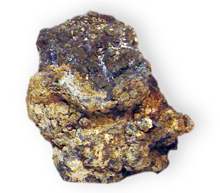
Arsenic is an odorless, tasteless semi-metal element that is abundant in the Earth’s crust and atmosphere.
About 33% of the Arsenic in drinking water comes from the erosion of deposits in the earth. The rest was added through agricultural and industrial runoff and emissions.
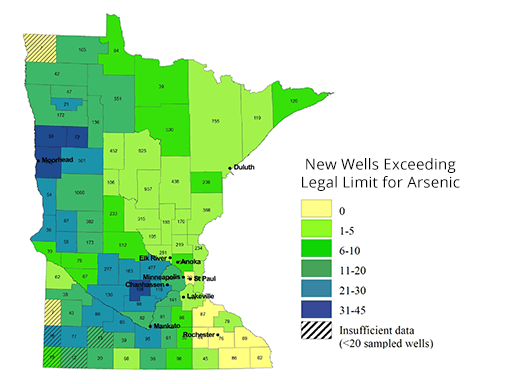
The Minnesota Department of Health estimates 15% of MN private wells exceed the legal limit for Arsenic. But some areas may be 2-5x higher than that. Communities like Shorewood and Deephaven have done a good job of educating and alerting residents.
Testing your water with a state certified lab is the only way to tell if you have an Arsenic problem.
There can also be Arsenic in city water. Cities perform regular monitoring and rarely exceed the legal limit. You can review your city’s annual drinking water reports to see if there have been problems in your water.
Different Types of Arsenic
In Minnesota, Arsenic generally occurs in two forms:
- trivalent arsenic (As+3, or arsenite)
- pentavalent arsenic (As+5, or arsenate)
Although both forms are harmful to human health, trivalent arsenic is more harmful and more difficult to remove from water.
Health Effects of Arsenic
The short term effects of Arsenic exposure may include stomach pain, nausea, vomiting, and diarrhea.
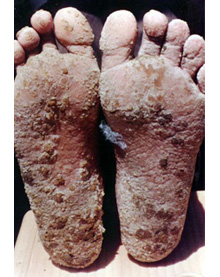
Long term exposure to Arsenic is quite severe. Partial paralysis, numbness in hands and feet, blindness, lesions, thickening and discoloration of the skin are all very common.
Arsenic attacks the body’s cells and can lead to cancer of the bladder, lungs, skin, kidneys, nasal passages, liver and prostate.
Studies have found:
| Health Effect | Concentration in Water | Study |
|---|---|---|
| IQ deficit | 11ppb, children; 30ppb, adults | Siripitayakunkit et al., 1999 |
| Skin keratosis | 50ppb | Mazumder et al., 1998 |
| Artery, arteriole, and capillary disease | 20-91.5ppb | Engel and Smith, 1994 |
| Abnormal electromyograms | 60-140ppb | Hindmarsh et al., 1977 |
| Spontaneous abortion and perinatal death | 60-270ppb | Dési, 1992 |
How is Arsenic Regulated?
The US Environmental Protection Agency (EPA) has two different guidelines for Arsenic in drinking water:
10ppb (parts per billion)
This is the maximum contaminant level (MCL), or the enforceable MCL for both organic and inorganic forms.
0ppb (parts per billion)
This is the EPA maximum contaminant level goal (MCLG) that has been shown to have zero long term health effects.
Available information from the Minnesota Department of Health (MDH) indicates that the following interpretation might be given to arsenic results:
- Less than 2ppb: naturally occuring arsenic, not a health concern.
- 2 to 9.999ppb: arsenic is present at levels lower than the EPA’s regulatory standard of 10ppb. The level may not pose an immediate health concern. However, you may wish to test you water periodically, especially if the arsenic level is close to the regulatory standard.
- 10+ppb: arsenic is present in your water at a concentration that exceeds the EPA regulatory standard of 10ppb. MDH recommends you seek an alternative source of water for drinking and food preparation.
How is Arsenic Treated or Removed?
Your first step should involve having a Qualified Premier Water Technician perform a FREE WATER TEST to determine the overall quality of your water. During this analyis, a sample can be collected and sent to a State Certified Lab to accurately measure the Arsenic levels in your water.
AS3 can be converted into AS5 in the presence of an effective oxidant such as free chlorine. Iron Filtration Systems that use a Constant Chlorine Feed can effectively reduce Arsenic throughout the entire home.
New, specialty Arsenic Filter Systems have become available to treat both AS3 and AS5. While these medias are efficient at removing Arsenic, care must be taken to ensure they are not damaged by other elements in the water like iron, tannins, or hydrogen sulfide.
Reverse Osmosis systems using a certified TFC membranes and HERO membrane systems have been shown to effectively remove AS5. The HERO system would be a good whole-house treatment alternative to an under sink system. If AS3 is present, a chlorination system or additional filtration would be required.